In our previous post we moved the arm and torso commands of a wheeled dual-arm humanoid onto the WIM real-time stack, which writes them to CAN directly, and measured on the bus whether each command left on its 4 ms schedule. Comparing cases with the same conditions, the p99 jitter was 17 to 62 times smaller.
One question was left after that post.
"Does the timing difference we measured on the bus show up in how the arm moves?"
We answered it with two phone videos taken on site. One shows the arm driven by the robot's stock control stack, the other by the WIM real-time stack.
In short, on the stock stack the whole arm vibrated together about 6 times a second (6 Hz). The points we tracked on the arm moved almost identically (correlation 0.99), and the vibration grew every time the arm changed direction. On the WIM stack that regular vibration was not there (correlation 0.11). The vibration was about 10 times smaller in screen pixels, and after correcting for the different camera distance we estimate it to be 3 to 5 times smaller.
The comparison video
Left: stock control stack. Right: WIM real-time stack. The graphs below each clip draw the arm vibration measured in that video as it plays, on the same vertical scale (after distance correction). Markings and logos on the robot body are masked.
How we measured it
To get the arm's vibration out of a handheld phone video, two things have to come out: how much the camera shook, and how much the arm moved on purpose.
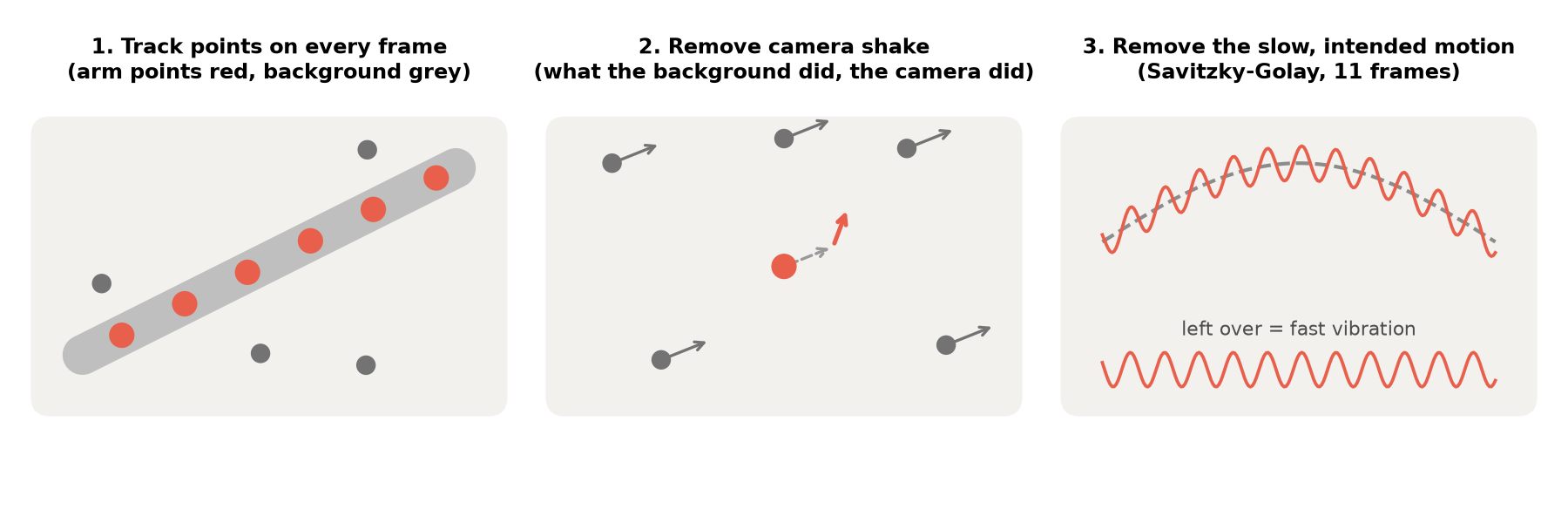
- Point tracking: for each 3 s window (90 frames) we picked about 900 Shi–Tomasi feature points and followed them with pyramidal Lucas–Kanade optical flow. Each point was tracked forward and then backward, and any point that came back more than 0.5 px off was dropped.
- Removing camera shake: on every frame we fit a rotation, translation and scale transform to the background points with RANSAC and mapped all points back to the first frame. Points that followed this transform throughout were treated as background, the rest as moving objects.
- Keeping only the fast vibration: the slow, intended arm trajectory was estimated with a Savitzky–Golay filter (11 frames, 2nd order) and subtracted. What remains is roughly the content above 3 Hz.
- How much the arm vibrates as one piece: from the arm region we took the quarter of points with the largest vibration, computed the correlation of their vertical vibration between every pair of points, and took the median. Tracking error makes each point jitter on its own, so the correlation would be low. A value near 1 means the arm is really vibrating as one body.
- Matching the scale of the two videos: the two videos were shot from different distances. Comparing the width of the head, torso and leg column, the stock-stack video was shot about 2.3 times closer. The "same scale" in the graphs below divides the stock-stack values by 2.3.
Result 1: 15 seconds of arm vibration
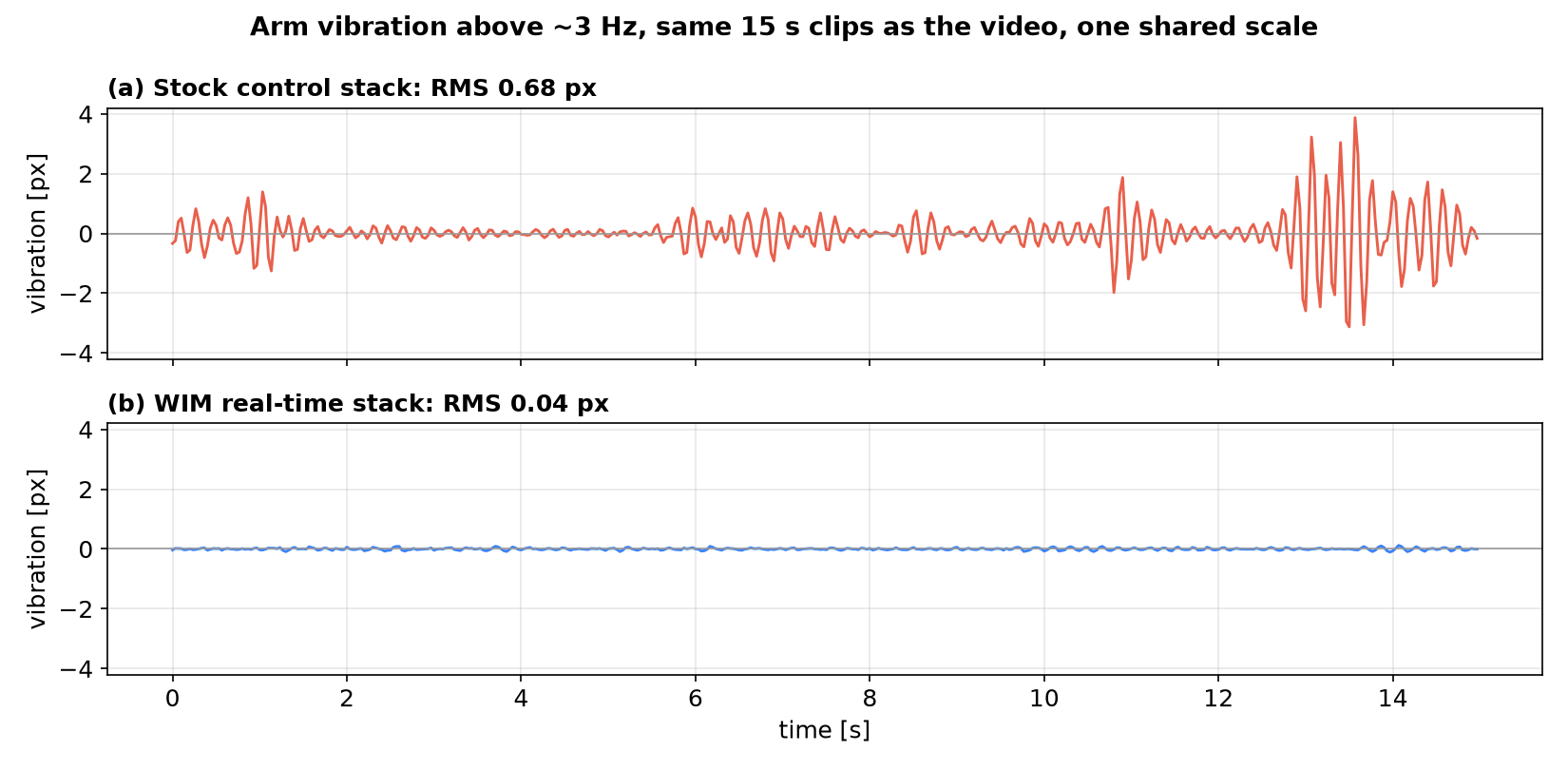
Arm vibration over the 15 s clips used in the comparison video (content above 3 Hz, both graphs on the same scale). The stock stack oscillates continuously at 0.68 px RMS and reaches 2 to 4 px when the arm changes direction (around 11 s and 13 to 14 s). On the same scale the WIM stack stays near zero at 0.04 px RMS.
Result 2: where the vibration sits in frequency
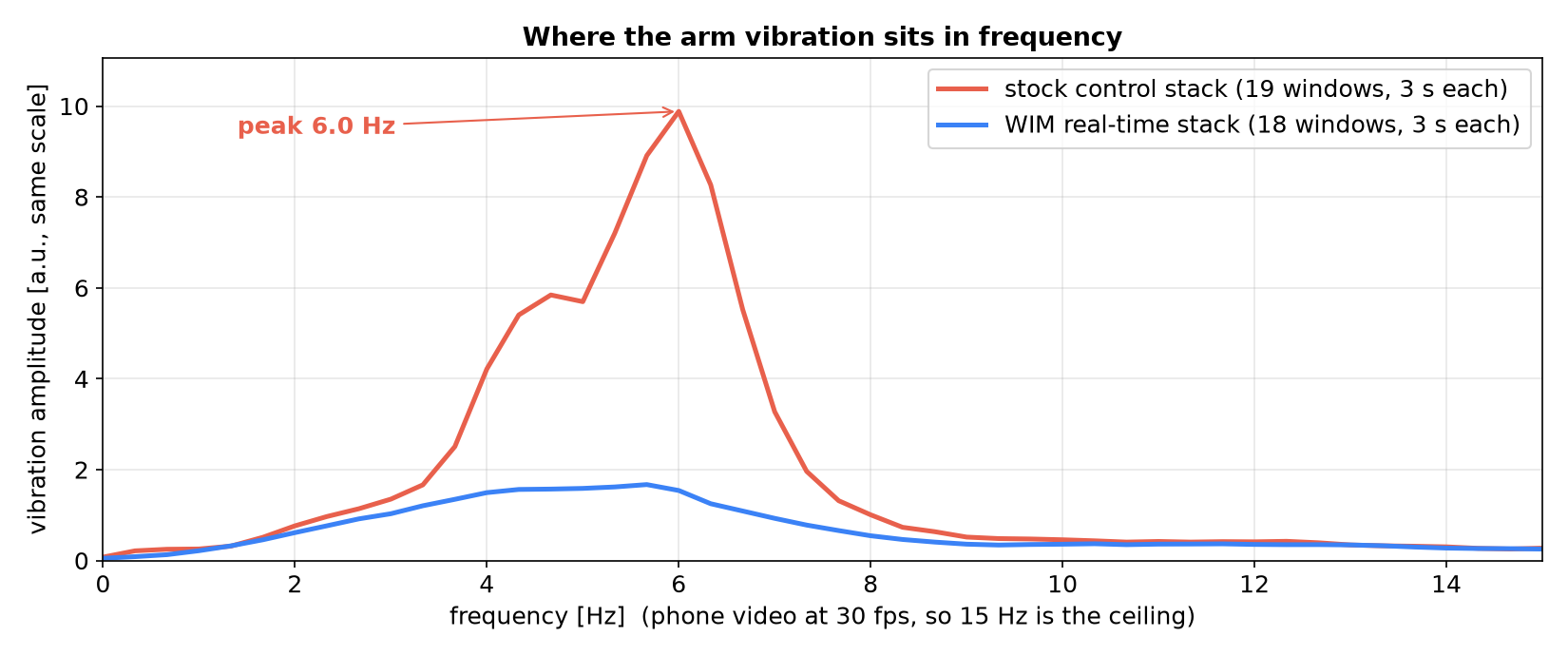
Frequency content of the vibration, computed for each 3 s window and averaged. The stock stack shows a clear peak at 6.0 Hz, which means a regular vibration is present. The low hump of the WIM stack is close to the shape of measurement noise after the same processing.
| Metric | Stock control stack | WIM real-time stack |
|---|---|---|
| Vibration peak | 6.0 Hz | none |
| Correlation of vibration between points on the arm (median) | 0.99 | 0.11 |
| Vibration RMS, median (screen pixels) | 0.50 px | 0.045 px |
| Vibration RMS, top 10% (screen pixels) | 1.36 px | 0.14 px |
| Noise floor of background points, top 10% | 0.024 px | 0.019 px |
| Analysis span | 60 s, 19 windows of 3 s | 54 s, 18 windows of 3 s |
The noise floor of the background points is similar in both videos: the measurement precision is the same, and only the arm's vibration differs. In screen pixels the stock-stack vibration is 10 to 11 times larger. Correcting for camera distance (about 2.3 times) gives 4 to 5 times, and correcting by the size near the hand (about 3.8 times) gives about 3 times, so we estimate the difference in vibration size at 3 to 5 times.
We checked the rest of the stock-stack video (60 to 254 s) the same way. Averaged over 64 windows of 3 s, the peak was again at 6.0 Hz, and in 54 of the 64 windows the peak fell between 5 and 7 Hz. The vibration was not tied to a particular moment; it kept the same rhythm through more than four minutes of video.
Why command timing turns into arm vibration
Digital control theory usually assumes equidistant sampling and a negligible or constant delay from measurement to actuation. When that assumption breaks, the same controller responds with more oscillation. That control performance degrades when other work interferes and makes delays vary is a long-studied result in real-time control (Cervin et al., "How Does Control Timing Affect Performance?", IEEE Control Systems Magazine, 2003).
In the previous post, commands from the stock stack often drifted off the 4 ms schedule, and a late command was sometimes followed by the next one going out right behind it. Seen from the motor, the targets do not arrive evenly; they pause and then jump. We believe the vibration in these videos comes from that timing irregularity.
This is an inference, though. Other things may have changed along with the command path, and these two videos alone cannot separate the causes, because we have not yet recorded timing and vibration in the same run.
Limitations
- The two videos show the same robot on different days in different places. Camera distance, angle and arm motion differ, and this is not a paired comparison from a single run.
- A phone records 30 frames per second, so vibration faster than 15 Hz is not visible.
- There is no length reference in the frame, so we could not convert the vibration to millimetres. The distance corrections for the size comparison (2.3 and 3.8 times) are estimates based on body width.
- We could not attribute the reduction to command timing alone (previous section).
Summary
The command timing difference we measured on the bus also showed up in the arm. On the stock control stack the whole arm vibrated as one piece at about 6 Hz; on the WIM real-time stack that vibration disappeared. What we changed was the path the arm and torso commands take to the bus. The application on top, the motor firmware and the hardware stayed the same.
Next, we plan to film both stacks from the same spot with the same trajectory while recording command timing. That will let us compare vibration size under identical conditions and check whether timing and vibration move together in the same moments.
If your robot starts to shake once the AI is switched on, try measuring the rhythm of the shake from a single phone video first. Just seeing whether a peak stands at one frequency is a useful clue to whether the problem is in the mechanism or in commands that do not arrive evenly.