Embedded/Real-time
Why Our EtherCAT Sync Fell Apart Every 110 Seconds: One Jetson Default, 328 µs to 3.5 µs
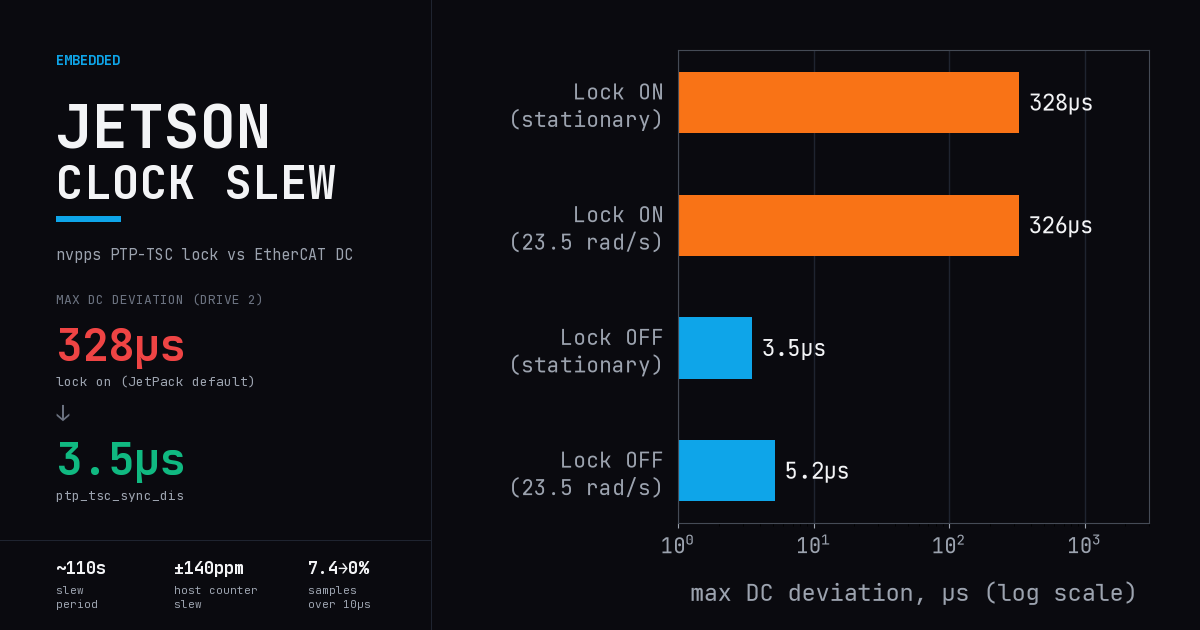
Running two servo drives at 1 kHz from a Jetson AGX Orin with the IgH EtherCAT master, the Distributed Clocks (DC) deviation between drives spiked to hundreds of microseconds roughly every 110 seconds. The cause was not the motors, the kernel, or our control code. It was the PTP-TSC hardware lock that NVIDIA's nvpps driver enables at boot. Disabling it with one device tree property cut the maximum DC deviation from 328 µs to 3.5 µs over a 20-minute run.